Sunday, October 27, 2013

Two Steps Forward...

Things change rapidly in India.  Often, the change is for the better, but sometimes, it's not.  I never thought my walk to work would be a microcosm of a changing country...

When I first moved here, and for who knows how many months before that, my typical walk from my neighborhood to that of our office transited past the neighborhood garbage dump, through a dirt road along side a building falling apart, through a trash strewn area ringed by barbed wire, to a lush, green pathway by a nice park and into a very luxurious neighborhood.  Elements of the walk point to the many dichotomies that are readily apparent here.


Each morning, a heard of cattle can be found at the garbage dump, rifling through the trash for any leftover morsels of goodness.  They are accompanied by a number of barking dogs that also search for scraps, and generally run the neighborhood.  The big building alongside the path appears to be the epicenter of something terrible that happened - but is likely a result of neglect.  The building has no walls.  The upper floors have fallen like trap doors, with concrete slabs swinging on still attached steel bars.  A number of families call the building home.  At night you can see their cook fires.  During the day, you can hear the screams of the children playing.  The trash strewn walkway is the border between two neighborhoods, one of the poshest in Delhi and one of a lower middle class.  The trash of both neighborhoods fills the walkway, even with the garbage dump 500 feet away.  Pigs often roost in the mud, dirt and trash in and along the path.  And then, in a two foot segment, the trash disappears in favor of a neatly laid path, with trees growing on either side that runs along a manicured park where morning walkers get their exercise.
There are lots of generalizations that can be drawn from this quarter mile stretch; from lack of sanitation or housing, the possible ease with which disease can spread, the vastly different degrees of wealth on either side of a fence, or respect for the environment.

But my focus is the dirt path.  A few months ago, a large pile of stone tiles appeared out of nowhere.  The stones were orange, red and white, and were triangular in nature with rounded, interlocking edges.  Within a few weeks of the neatly laid pile appearing, almost overnight, half of the dirt path became neatly covered in stone tiles, starting at the garbage dump and neatly laid until the stones ran out - about a third of what was necessary to pave.  That first walk along the path... was .... luxurious.  It was neat, it was clean, it was pretty - for the 200 or so feet until it returned to dirt.  I was anxious to see if the path would be finished.  But after a few days, after a few weeks, the newness of the path receded.  Piles of cow poop would appear in the morning.  A layer of grime, consistent with most of the streets, began to make the path, although still much nicer than the dirt path, 'fit' in.

Then, after an absence of about a month, I was shocked to see the path dug up.  A pipe was laid and covered over with a mound of dirt.  The path was worse off than it was before - when it was just a neat dirt road.  Now it was haphazard rocks and tiles, smeared with dirt.  It struck me - the lack of planning, waste of effort to lay the tile on the path, waste of resources in the tile.  Its apparent that the path has resumed its normal 'fit', as the well trodden trails have found their way up the mound and around large rocks.

After a few more months, the tiles along the path were repaired.  Following that, concrete was poured at the end of the path to form a parking lot, which is now full of parked cars and kids playing cricket in the morning.  Still, one section of dirt remains.  I would call it charming, if it weren't between two barbed wire fences, uneven and rocky, often covered in animal poop and trash.  What will the next step be here?  Dig it up again for another pipe?  Another expansion or addition?  Of fix the path - which is heavily trodden, but lies directly between the oversight of the two neighborhoods.

Is it a microcosm of a country and an economy that is unpredictable?  With constantly changing regulations and an ability for those at the top to change directions instantly?  A plethora of resources, but disagreement on how to apply them?  A lack of overall plan?

Its probably none of these - and just another day in India.  Two steps forward, one step back.  Two steps forward, one step back.


Sunday, September 29, 2013

Want a massage? Get a haircut.

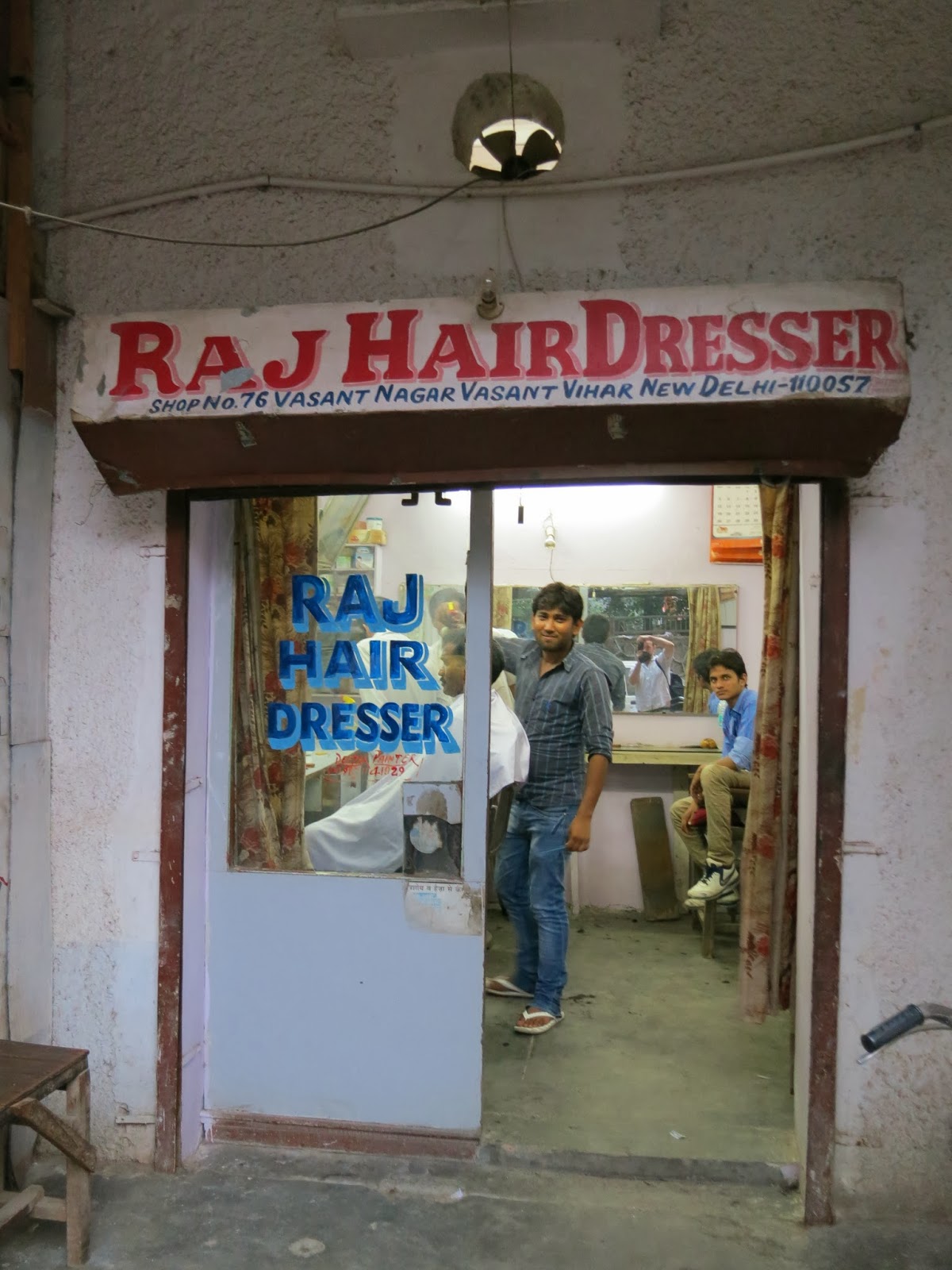
One of the many local barbers in Vasant Gaon, New Delhi.
There is something special about getting a haircut in India.  It doesn't much matter whether its a barber shop with 4 walls, or if its a chair facing a mirror dangling from a nail on a tree.  Both are prevalent in India, and the service you will get at both leaves most Western shops looking like mechanized sweatshops in comparison.  It helps that the average Indian male cares an awful lot about his appearance - his hair, his mustache, his armpit hair.  The barbershop becomes the place to sit, gossip and sip chai on weekends.  Its the place to hear the latest Bollywood tunes blaring from the mobile phone of the barber.  This is the Indian equivalent to the woman's day spa - but all male, all the time.

Want a face massage?  How about a scalp rub?  No - just a quick drop in for a mustache trim?  Take a seat.

There are typically a few paintings of Hindu deities hanging from the walls.  There is hair dye in case you want to give a little uplift to your beard.  Wires dangle precariously from electrical sockets - but hey, what did you expect?  There are a few hairs from the last few customers, but once you take a seat in a barber chair from the 1950s, all the atmospheric noise dissipates.  The barber, or rather, hair 'artist', will pay immaculate care to each hair on your head.  No electrical clippers here, thank you, just old fashion comb, scissors and straight edge razor.

There is a method to the madness.  First, always, is the trim to the sideburns.  Gradually, the scissors, comb and fingers work their way around the rest of the head.  A sprinkle of water later, and the cut moves up the head.  Don't forget the bangs.  Then out combs the straight edge razor.  This is broken in half.  The first half is used to shave the hair around the ears to make an unbelievably trim, straight, clean line of hair.  There is a constant eighth of an inch of clean skin between ear and hairline.  This line follows the back of the head, and finishes off phase one - the haircut.  Then the talcom powder.  Then the brush of the talcom powder off of the shaved areas.

Intermission.  Massage time.  A series of claps, hand bangs and fingers massage your scalp after the haircut.  This serves to one, feel great, and two, to get all the loose hair off your head (pet peeve...).  Relax and enjoy it.

Have a mustache?  If you are Indian, the answer is yes.  Beard?  Clean shaven?  Fine.  Sprinkle a little water on your face, then a bit of shaving cream gets foamed up in a dish with a brush before application to the face.  The other half of the straight edge razor now comes out, for a close, clean shave.  Then a trim of the beard/mustache/facial hair - with scissors, comb and fingers.  There is a reason that Indians are known for their mustaches - and it all has to do with the care and loving attention of their barbers.  Talcom powder.  Brush.  Second sprinkle of water and then the towel.
Anil is the man.

Intermission number two.  Yes, this might be where Bollywood got the mandatory intermission idea.  Face massage.  The fingers behind the towel hit the cheeks, the lips, the eye sockets.  Your temples.  You are a wet noodle.

Chiropractor?  Unnecessary.  The barber can do that too.  At this point, you are a piece of clay.  Your arms get bent in directions you didn't think possible, your back cracked, your neck massaged, all from the comfort of the barber chair.

Time for the final touches.  Face cream?  Hair gel?  Need five minutes before you can talk again?  No problem, have this chai and relax.

Price tag?  $2.

Thanks Anil.


Wednesday, September 25, 2013

The end of the Monsoon

Bumper-to-bumper traffic on Ring Road following heavy rain on Monday. Photo: R.V. Moorthy
When the rains come to India.

As the monsoon comes to an end in Northern India, so does my tenure here.  The deluge last week caught many off guard, although the growing, grey clouds were visible atop the skyline of New Delhi.  The rain lasted in spurts most of the afternoon and evening; at times coming down at an outright downpour.  The streets flooded.  Remnants of the water and its effects were visible the next day.  This is nothing new, as the monsoon, sporadic in its yearly intensity, is a comfort to much of India and very common occurrence.  It indicates the beginning of a planting season, the availability of mouth-watering mangos, and gives life to the rivers of India.  And yet, despite its predictable inevitability, common sense approaches to deal with the negative consequences – flooding of open sewers, roads turning into impassable waterways, open water breeding of mosquitoes leading to outbreaks of malaria and dengue – are consistently overlooked. 


I can’t help but wonder about the many things that appear common sense to my foreign eyes – even after nearly a few years here, which merit little notice or attention to others.  

To my amazement, annual monsoon preparation entails an army of workers, armed with shovels, sent out to tackle the sewers.  Workers are hired to manually ‘desilt’ the drains and sewers of the country.  These men user their shovels to excavate the trash, sludge, mud and excrement that has been accumulating for the last 9 months.  A ‘desilted’ drain usually has a stinky, black, tarry line of goo abutting the length of the drain piled neatly alongside.  The first rain usually washes half of it back into the drains and the other half back onto the streets.  This is one of the many things I find mind boggling.  Is it still a surprise when the monsoon brings flooding – leading to damage and havoc

Wednesday, February 13, 2013

Its a Small World After All


"Hey man, 'dis is Kashmir".  Our taxi-mate we met at the airport yells down from the roof rack of a land cruiser, perched upon the ski bags, as we negotiate the rate with a new taxi driver in broken English with a thick Russian accent.  Monkeys jump from branch to branch in the pine tree behind us, with snow-clad hills in the background.  The snow on the street has melted into a muddy soup.  After about 15 minutes more of bargaining, after a spending the entire day in transit, my patients runs thin, especially considering that we are bargaining over 100 rupees, or about $2.  I've long learned my lesson bargaining in India between the fine balance of saving a few dollars versus saving a few minutes.


Soon another land cruiser comes careening down the street, pulling right up to the first one.  We finalize a price, pass the ski bags from one roof rack to another, pile in, and off we go.  The car has a chain on one tire (which is about as bald as all the rest), and a driver who immediately puts on a pair of pink aviator sunglasses - which go oddly well with his neatly parted hair in a Bollywood sort of way.  Ricocheting up a partially plowed road to Gulmarg, the main ski resort in India, my mind gets blown.

My flatmate from Delhi and I are sharing the 4x4 taxi with two Russians we met at the airport.  We start chatting, and it turns out one is from the Kamchatka peninsula (if you don't know where that is, google it right now...).  I nonchalantly mention that I happen to have spent some time skiing there as well.  He seems surprised, and asks where.  Most people couldn't place his home on a map, let alone have set foot there.  I mention a few stories from our trip there, including squeezing into a bus with skis and getting dropped off at a random kilometer post in the wild.  It turns out he is a heli-ski guide in Kamchatka, on a bit of a vacation before the season back home picks up spending the next month skiing in Kashmir.  When I mention a backcountry ski race in Avacha pass...  and he asks the year I was there...  and we realize that we were in the same competition....  and that he remembers me as the only telemarker in the race....  an odd, serendipitous moment passes, where we both feel awkwardly close and amazed at as stars, planets and moons align.

The world gets a little smaller.

Is this just odd chance, coincidence or serendipity?  Or has the world become a narrowing of self-selecting groups of people who share similar interests, a passion for travel, and the means to do so - who will naturally run into each other or unwittingly pass a friend of a friend of a distant acquaintance?  Or have our social circles grown to intersect similar circles from distant lands, merging into one and the same?

Does six degrees of Kevin Bacon now apply to... anyone?


Tuesday, May 29, 2012

Chaos Ensues

A friend on a recent visit to Delhi pointed out that traffic and people flow through the streets here like water.  The teeming mass of cars, small and large, bicycles, rickshaws, auto-rickshaws, cows, goats, motorcycles and humans find their way to fill every possible niche the roadway has to offer.  Its amazing.  Sometimes, however, this leads to disastrous consequences.  Allow me to illustrate.

a) A simple railway crossing, two cars approach from opposite directions. The gate for the approaching train descends.  The cars kindly slow, stop, and patiently wait for the train to pass.

b) More cars approach as the train (this one happens to be either really, really long, or really, really slow passes). Cars in the back of the waiting line of cars, a little less patiently, decide that they might be able to squeeze ahead of the entire queue if they saddle up next to the front most car.

c) Cars even further back don't know what is causing the traffic, don't see traffic on the other side of the road, and decide to approach the intersection on the wrong side of the road, only to find that they too, have to patiently wait for the train to pass.

d) The train passes.  The gates rise, and the drivers are stuck, staring at each other, scratching their heads.

e) My favorite part: Chaos ensues.
(insert your own picture of chaos on the streets of India here)

Ah, and this was just with cars!  Imagine trucks, buses, cows, motorcycles and bikes thrown in the mix.  Real chaos!  Gotta love it.


Saturday, April 28, 2012

(India) Pale Ale

Its not often that I've been called a snob.  The thought of even dawning the cape of 'beer snob' was even more unthinkable.  I have known a few self-proclaimed beer snobs in my day, and I can assure you, that I never thought I was one, nor did I think I ever could be.

However, I think everything, even being a snob, rests in context.

Here, in India, I have fallen prey to the lack of bitters, sours, darks, malts, porters, stouts, wheat beers and, well, generally, decent beer.  Options in most stores and bars involve Kingfisher Light, Kingfisher Strong, and recently, Kingfisher Blue (labeled with a fancy blue metallic sheen that proves its quality).  These beers are 'different' from each other, but primarily only in terms of alcohol content.  Higher end establishments will carry a few run of the mill 'premium' beers, like the Danish Carlsberg or lesser known Tuborg, the Dutch Heineken, the American Budweiser, the Australian Fosters - and on special pricey occasions, the Mexican Corona.  Taste the great beers of the world!  With that selection, its no wonder people stick to the Kingfisher!  There is something called a 'Godfather' and a 'Thunderbolt', but they fall into the same category as Kingfisher Strong; they feel more like malt liquor than anything else.  These cover 99.9% of the beer options available in India.  If you were to pour these beers into beautiful pint glasses and line them all up to each other, the would NOT look like this:
Yet, after a rant like that, how could I not be called a beer snob?  As many friends of past can affirm, with my affinity to PBR (before it became annoyingly hipsterish), and probably more relevant, my penchant to save money, forever relegated me to the legions of beer appreciators - but not beer snobs.

Yesterday, while I was delightfully enjoying a Kingfisher, a thought crossed my mind that at first got me curious, then a little riled up, and now mildly incensed.  Why can't I find India Pale Ale in India?

A friend always used to tell the story of England putting extra hops into beer to make the journey by ship from London to Bombay.  Turns out this is false, but that large quantities of the beer were shipped to India to satiate the thirst of the East India Company.  There are lots of left overs from British occupation, but this isn't one of them.  Fine, how about just Pale Ale then?  

Tuesday, April 17, 2012

On Parade!

There I was, sitting on a train, minding my own business.  I was admiring the passing Indian countryside between typing notes on my computer - taking advantage of the smooth, slow train ride to squeeze in some work time.  A young Indian teenager suddenly took the seat across from me.  He looks at me, and then looks at the newspaper he is holding.  Back to me.  Back to the paper.  Then he points at an article in the paper.  To be precise, this article:

'Foreigners join Republic Day Festivities'. 

Turns out it's pretty hard to be a foreigner in a small town and not attract quite a bit of attention.  Depending on the location in India, you are either unnoticed or bombarded with attention.  Such was the case the morning of Republic Day.  We got a special invite to join some local friends and watch a small town parade.  As we approached the parade grounds, tractors pulling floats filtered in from farms and side streets. 

We past the parking at the open air-stadium, and continued straight into the stadium; there were foreigners in the car!  The car pulled up right next to the floats.  We got out, and angry looks melted into inquisitive ones.  Dragged by the arm away from the floats, we went straight through the middle of the field.  Through the ranks of soldiers lined up in formation with guns, in full regalia.  The ranks parted, not with angry faces.  The soldiers all got out their cell phones and started taking pictures.  Some even posed with us! 

In a whirlwind, we had been through the ranks, introduced to this person and that, met journalists, and were suddenly, in the parade.  Behind the tractor with the education float, aside the girls riding bicycles in formation, we walked slowly around the stadium precisely once, starting after the soldiers also performed precisely one round of the stadium in front of the large, enthusiastic crowd.

Ah yes… on parade!

Tuesday, April 10, 2012

Mobiles vs. Toilets

To a Western audience, these headlines in a respected daily newspaper would turn heads and draw jeers.

“Woman rewarded for sparking ‘toilet revolution’ in her village”

“Half of Indian popln defecate in open, but more have mobile”

“Women want mobiles, not toilets, says Ramesh”

To many, they are the signs of impoverished nations, racing along a chaotic track of development. Perhaps. The headlines are even sensationalist to a certain degree here, in India (but here, that is why they get published in the newspaper in the first place.)

Upon closer inspection, outside of the sensationalism, I think they illustrate a momentous trend. Mobile cell phones are transforming lives.

Think back ten or fifteen years ago. Did you have one of the early model mobile phones? What did you use it for? Was it a supplement to your daily life? A new-fangled, must-have gadget? A leash for your spouse, parents or children? Or was it a lifeline, a symbol of your livelihood, a technology with the potential to transform your economic outlook.

To many in the Western world, cell phones complement our daily lives, bringing information to our finger tips, connectivity in remote places to our loved ones, and near constant connection to an interconnected world. In many developing countries, however, the potential is so much greater.

Yes, I can quote impressive numbers of mobile subscribers in India or the growth rate of mobile phone penetration. I can link to fancy graphs of mobile phone penetration per 100 people or a host of other hard stats, facts, and blurbs – but these astronomical numbers have a hard time conveying the reality on the ground. Mobile phones are changing the behavior of millions of people, something that non-profit organizations and NGOs have been trying to do for decades through health and education outreach.

Take the first article mentioned above, “Woman rewarded for sparking ‘toilet revolution’ in her village” published in the Hindustan Times on February 16, 2012. The first paragraph reads:

“A woman has been rewarded for her “bold” decision to leave her marital home within days of the wedding to protest the lack of a toilet in the household, an official said on Thursday. Anita Narre was handed $10,000 by Sulabh International, a non-profit group, for refusing to defecate in the open and sparking a “toilet revolution” in her village in central Madhya Pradesh, according to the district magistrate.”

This first article isn’t so much about mobile phones, but is here to set the scene. Extremely traditional values of marriage and the role of a wife are thrown to the wind as she protests at the lack of a toilet in the household. Often viewed as ‘dirty’ if they are inside a home, the majority of Indians relieve themselves almost at will, anywhere they see fit (its not uncommon, even in Delhi, for cars/scooter to pull off of the road, stop traffic, and go to the bathroom on the sidewalk.) But I digress… The barriers of sanitation and hygiene are tough to break – and sometimes its something so counter-cultural, like a wife’s bold decision to leave her husband over the matter that makes a bold enough statement to draw attention.

“Half of Indian popln defecate in open, but more have mobile” - Hindustan Times – March 14, 2012.

“Half the country’s population may not have a toilet at home but they are not without a mobile phone. Bringing to light this feature of the population, Census 2011 data on houses, household amenities and assets released today said 49.8 per cent Indian households defecate in open but in sharp contrast 63.2 per cent households own a telephone connection, 53.2 per cent of them a mobile. The data reflected the controversial remarks of Union Rural Development Minister Jairam Ramesh who said recently that women demand mobile phones but they are not demanding toilets.”

This headline may also be an eye opener – but only to Western eyes. To many in the developing world, this is a no brainer, as mobile phones are one of the first items a family invests disposible income in when they start to move up the economic ladder.

Jonathan Donner, a thought leader in the field at Microsoft Research, explains in a paper in much more detail and eloquence outlined here the power of a mobile for the developing world.

“The burst of connectivity in the developing world during the decade of 2001-2010 has made telecommunications accessible for half the world. This promises to change the configuration of people to each other and to the formal/global economy, which has excluded so many of them. It is going to do so in ways that are tied to social locations as much (if not more) as to economic transactions. Symbolically, blurring reflects and drives societal beliefs about the mobile. The telephone helped shape the economic landscape of the 20th century, reflecting and reinforcing some locations in economic and production networks, while excluding others. Widespread mobile use promises to reduce that exclusion. Yet, for individual users, the mobile it is not merely a symbol of economic development or productivity. Rather, it is one of self-expression, agency, and social connection as well.”

And to tie it all back to toilets, the last article in the Hindustan Times: “Women want mobiles, not toilets, says Ramesh”.

“Sanitation is a much more difficult issue (than telecommunication). Now we are talking of behavioural changes, and women demand mobile phones. They are not demanding toilets. That is the mindset we have.”

The article goes on to state, “Ramesh said that India is a land of paradoxes, as the country accounts for almost 60% of those relieving themselves in the open across the globe – at a time when it has 700 million mobile phones. “(There is) 60% of open defecation in a country which has 700 million mobile phones. ….We build toilets but the toilets are not used.”

I can assure you that those 700 million mobile subscriptions are being used.

Sunday, March 25, 2012

Time flies when...

...when you're having fun, right? Or busy, very busy. The last few months seem to have flown by, as the pace and intensity of work has increased and eclipsed my ability to blog. I hope to remedy that soon. But that day is not today.

Instead, I want to link to a few blog posts from our Dimagi staff blog that show that our company is... um... different. I haven't worked too many places where the whole office self finances a trip to another country for a month to work there.

Failure? No. Success? Not as clear. In some ways, absolutely. For increased short term productivity? Not definitively. For increased long term satisfaction and happiness with the company? See for yourself.

The description:
http://www.dimagi.com/the-away-month/

And the outcome:
http://www.dimagi.com/dimagi-in-brazil-or-why-you-should-stop-worrying-and-learn-to-love-making-your-employees-lives-awesome/

Monday, January 23, 2012

45 Minutes in Nepal. A Saga.

It started early last week.  The project I'm currently working on is in a remote part of India.  So far, its been one challenge after the next.  Scheduling anything with the rural health workers has been near impossible, who all have a busy schedule and often overwhelming responsibilities.  All week, we attempted to plan for an all day training session on our mobile phone software for them as a job aid.  Due to a Polio vaccination campaign that lasts for a week every month - which was changed at the last minute - our only choice was last Friday.  

By late Tuesday, it appeared that we were successful in scheduling Friday with all the government players.  By Thursday, we discovered that Friday morning had been rescheduled for a common immunization day, and we would have to settle for Friday afternoon.  Friday morning, we discovered the immunization day was canceled, and the whole day was ours if we had planned ahead for it.  We arrive in the village at noon.  Since the immunization day was canceled, our workers are spread throughout the village, and it takes a coordinated effort of calls to track them down and encourage them to come for the training.  We start by 1245 - and things proceed smoothly.  Just after 2pm, however, we get a call from the health ministry instructing us to release half of the women from the training so that they can open bank accounts, the newest, highest priority of the day.  Such is life in India.

During the afternoon, as my colleagues salvaged the training with the remaining rural health workers, I stepped outside to do a little bit of work.  The limits of my Hindi were limiting how much I could actually contribute to the training.  Our driver came and sat next to me, cranking away on my laptop, watching my fingers dance away on the keyboard.  He asked for my passport picture.  People here are always asking for my picture, but I didn't have one on me.  Instead, I reminded him that his phone had a camera on it, and to use that instead.  He did, but clearly wanted a hard copy.  I thought nothing of it, as I then was encouraged to pose with the driver from our partner organization for another set of pictures.

After a long week, the team decided to head to Nepal for the day, with the hope of seeing a different land and perhaps a few mountains.  We arranged for the same driver we had been using all week for early Saturday morning, and headed north for Nepal.  After a quick 2-3 hour drive through a mix of scenic farmland and bustling towns, both with enough people, rickshaws, and cows on or along the 1.5 lane road to draw constant honking from the driver. (to warn them of our approach, around blind corners, to pass, to scare them out of the middle of the street - the horn here is annoyingly useful.)

At the border, we got out of the car and had a quick exchange with the border guards in Hindi.  We didn't catch all of it, but were able to proceed without further delay - no visa, or a stamp in the passport.  

The first thing that became obvious in Nepal, was the lack of our car horn.  As I looked around, the serene farmscape remained, but the plethora of people, animals, and things was reduced.  It was calming and peaceful.  We soon arrived at a large damn, where snow melt from the Himalaya is controlled for the farmland across the border in India.  Every few years, it floods and kills a number of people.  At this time, the water was extremely low, and we walked alongside on an elevated dike, into the misty morning, away from the road, and along the streambed.  Peaceful.  The dramatic drop in population density was overwelming.  

After about 45 minutes, we got back in the car to continue our adventure into Nepal.  This is where the story gets interesting, as our driver turns back towards India and crosses over the border.  We start asking what is going on, if there is a problem, and he mysteriously says no, that he is taking us to a market in Nepal where we have to go around in India for a bit, and that the car doesn't have the proper registration to go further into Nepal, hence the quick and painless border incident.  

Here is where the lack of Hindi is frustrating.  Our driver probably understands more English than he conveys, but doesn't speak it.  One coworker is an American of Indian descent and speaks Gujarati - a dialect from further South - and is our Hindi speaker.  Her Hindi is good, but not perfect.  The other coworker and myself are working on our language skills, but we are at about the level of a 3 year old.

Soon enough the car pauses and parks.  The driver says that the market is just on the other side of the border, and that we should walk.  Here again, we cross the border with no issues, and proceed to a run-down border town with a few shops.  Clearly no tourists come here.  Especially American ones.

We press the driver for more information, as the day is still early and our agenda of things to do in Nepal is still full, it is increasingly apparent that his own, separate agenda, is just about complete.  A crowd gathers as we (our female Indian colleague) talk to him about our options.  Crowds usually gather around us when we stand still for too long in this part of India, so we are unphased.  The driver, however, starts walking to ditch the crowd, and tells us that he doesn't have a driver's license, and that is why we can't go further into Nepal.

Right.  No driver's license.  From our hired driver. 

Granted, he looks a little young, and is not the most professional, but does a good job driving.  As the larger picture starts to come together, we walk back to the car and discuss our options.  Clearly our intended foray into Nepal is not going to happen.  The driver shows us his driver's license.  It was printed in 1989, is tattered and torn, and has a picture in it that is clearly not him.  The birthday printed on the license is 1978.  The driver is 19.  He pulls out his passport picture and places it over the other picture.  He explains that even though he could change the picture, he won't be able to change the birthday, or enough other information to make the fake legit.  If I give him my passport picture, however, we could quickly make a fake, and then switch spots for the brief instant across the border.

Uhuh.  Our hired driver wants my passport picture to make a fake driver's license of me so that we can cross into Nepal.

After brief consideration - we decide better.  We head back south to the town we are working in, deflated and frustrated.  Clearly this is why he asked for my passport picture yesterday, as we had inquired about the possibility of driving to Nepal over the weekend.

So I've been to Nepal.  It was peaceful and calming.  It was a fantastic 45 minutes.

Sunday, January 15, 2012

Like a Sore Thumb

It took a lot of effort this morning to go for a run. First run in the rural village I will be for the next few weeks. It was a cold morning and my bed was quite warm. Most of all, it was overcoming the thought of sticking out like a sore thumb that was the hardest.

Intense curiosity, at a distance.

Like a zoo, except I'm the object of interest.

When I returned from my run, hot and sweaty, even though the temperature outside was still chilly, I paused to stretch outside of the hotel. I had passed a man standing on the street opposite the hotel, who incomprehensibly watched me approach, stop, and stretch. I looked up after a few minutes and realized he had turned, to face me, and continue watching my strange ways. I kept stretching. I could see him inch a few steps closer with each passing minute, but never getting too close - a cautious distance from a wild animal. The next time I looked up, a gathering of about 5 children had also stopped to watch, also at a safe distance.

I was still sweating, beads dripping down my face, pooling on the ground below. I wore running shorts, running shoes, and a long sleeve top. It was cold enough outside that there was probably steam rising from my head. The observers were covered from head to toe, ready for a winter storm. I finished stretching and greeted the crowd in Hindi... namaste.

As if the trance was broken, the man inched towards me and started speaking in broken English. He asked what I was doing here and for how long I would be in town. He works on a renewable energy powerplant in a nearby flood-stricken area.

I sometimes struggle with the stares and attention. Its not easy to stand out. It takes backbone and a cognizant effort to ignore the faces of passersby and pretend not to notice. Its not personal.

If a man with purple skin and a space suit walked down the street, I would probably stare too. Out of curiosity. Out of an interest in why he was here, in my town, and where he came from. And I would hope that I too, would have the guts to approach him and to ask him about himself.

Tuesday, January 10, 2012

The Innovative Indian

I don't have a personal hatred towards pennies.  They have never really done me any wrong.  I always get a little kick out of finding one on the ground.  However, I never have much use for them, and for that reason alone, I know a number of people who despise them.

I've noticed a few things in India, and one of them is how innovative things can be.  Take the penny for example.  In India, one US Dollar is approximately 50 Indian Rupees.  There are lots of small coins around, however in India, they can be worth something - depending on the person.

Recently in a coffee shop, when I went to pay, I was told that there were no 5 Rupee coins - the equivalent of about a Dime.  Slightly taken aback, I was handed a small, 10 piece packet of Orbitz gum instead.  The more I think about this - the more brilliant I think it is.  This company has taken what many consider a neglectable amount of money and have found a way to improve the value of it for all parties involved.  Although the majority of Indians would not consider 5 rupees worth anything, the type that would buy a cup of coffee in an establishment like this (100-300 INR for a cup of Joe, depending how fancy) would not.  

Instead of being given a piece of metal they would just as well cast on the street, they are instead being given a packet of gum - which after a cup of coffee, can be a welcome commodity.  A nice surprise, it is likely viewed to the customer to have more value than the 5 Rupee piece.  To the coffee company, the actual cost of the small packet of gum is likely less than 5 rupees.  In effect, they are making money by not giving out the full amount of change, and are probably making people happy about it.

Brilliant!

Or, I could be delusional, and that specific coffee shop might have run out of small change, and didn't want a lot of caffeinated, pissed off people running around town spreading rumors about the company for not having the foresight to carry enough small change.

Either way, Im caffeinated, I've got a little extra kick in my step AND my breath smells good!

Wednesday, December 21, 2011

The Mountains Beckon...Still

I didn't know quite what to expect in India. I had high hopes in Zambia of taking my love of the outdoors with me - hiking in the bush, camping, etc. Ah yes, naive me. There are lions and elephants in the bush there. There are more things there that want to eat you than you can shake a stick at. Literally. On my move to India, I made the conscious decision to leave a lot of that camping gear behind. It had come in useful in Africa - but felt like overkill. The Himalaya are close - but am I going to be able to squeeze in trips to Tibet or Nepal? Reluctantly, I packed light.

At first it didn't seem like a big deal. Moving quickly from business in Mumbai to Delhi to Bihar - I didn't have much time to go hiking, nor did I find any areas to do so aside from a bit of urban exploration. Alas, mountains inhabit the Indian spirit. Some Hindu gods are said to reside in the mountains. Without looking too hard, the mountains in India found me. Or at least they are trying to.

I attended a talk by Stephen Alter, a prominent writer on Indian culture, mountains, and his childhood there. The pictures drew me in. At the talk, I met the head of the Himalaya Club in Delhi. Turns out, his dad was the leader of the first Indian party to summit Everest, the third group to ever summit the mountain, in 1965. I met with him again a few weeks later to share stories, advice and pictures. He runs a mountaineering themed hotel, where all of the rooms are named after famous explorers, climbing pictures adorn the walls, and a rock wall scales up the lobby four floors to the skylights. Its the only indoor rock wall in all of New Delhi. Indoor.... That's because I was also introduced to an amazing outdoor rock wall. Yep, just about in my backyard, a great, big monster of a wall with sport routes and gnarly overhangs that nimble little Indian kids can scamper up, but I have no chance. And just to rub it in a bit, I found a posting for a guy leaving town who was looking to offload his climbing gear.

I think the signs just all point in one direction. The right direction. To go higher. I'm heading to the mountains of Colorado for the holidays, and you can be sure that I will be returning with a large bag of gear. Who knows what mountainous adventures await. Its because the mountains beckon. Still...and always.

(picture courtesy of http://www.sikhspectrum.com/)

Friday, December 9, 2011

Pre-Season Training for Steely Thighs

Its true. Ski season is upon us. But here is sunny New Delhi, it seems far, far away. For those with closer access to the ski hills, this post will not help you. For me, its probably more cathartic than anything else. On with it.

I have a date with a ski mountain at the end of this month. I'm getting butterflies. I wake up at night in a cold sweat. What will I do? What will I say? Will the mountain like me too? I think this date requires a little preparation.

Waking up in the middle of the night in a cold sweat, is, unfortunately, not that far from the realm of reality. My worst nightmare: I'm so out of ski shape and practice that my first day back on the slopes is one of pain, misery and embarrassment. Yes, the first day telemarking of the season always involves a little bit of pain and misery, but pre-season training can help relieve the pain and set the correct frame of mind. With these sunny days, cows strolling in the street, and chai-wallahs relaxing on the street corner, telemark prepped thighs and a snow-steeled head are far my daily reality. I think I've gotten to the stage where my fear is slowly morphing into the motivating factor to get into ski shape - and to ensure I don't lose gnar points for making hot tub runs or call the day early to head for the bar.

I have dawned my running shoes, shorts and shirt and gone running a few times a week for a few weeks now, and the looks of locals are always the same: those that acknowledge my presence indicate no friendliness in their faces. Blank stares. Incomprehension. Most avoid eye contact, encouraging me to do the same. There are the few who say hi, or give a sign of encouragement. A few kids will give high-fives or say how are you, but its nothing compared to the onlsaught of village kids chasing after you for a mile or so smiling and yelling, and then asking for money, like I experienced in Africa. The runs are fraught with other obstacles, including deer, peacocks, pigs and unruly kids - yes, even in New Delhi. I also heard stories of eight foot angry cobras - but that's personally unverified so far.

But solid prep for skiing and telemarking requires more than a sauntering jog. Thighs of steel don't come THAT easily. So here is the Theis Delhi Telemark Workout Plan:

1) Lunges. Lots of them. You really can't do too many lunges. If you thought strange looks came from running, than you haven't seen anything yet. Choose a side street, alley, or walkway in a park. Uncrowded if possible, because the jaw-dropping looks might cause you to fall over when your legs are at the throbbing brink of collapse. Don't let that stop you. Continue to lunge until your throbbing legs do collapse.

2) Wall sits. Having a mid-day cup of coffee? No need for a chair - just pull up a wall. How about brushing your teeth? Need a work break? Better yet, encourage a colleague to a wall-sit-off. Yes, competition IS a motivator.

3) Mountain climbers. Let me guess, you haven't done these since you were in elementary school, right? Well (whisper), me neither. But don't let that stop you now. Breathless and panting, keep those legs moving as fast as you can. How else are you going to get those seamless turn transitions in the deep pow?

4) Jumps. Find random things to jump on. That park bench - yep, up and down. Three sets of 30. Now. Go. That awkward half stone half dirt curb - perfect. One leg only, up, down, side to side, up, down, side to side. Switch legs. Tired of jumping on things? How about done that dirt path over there? 20 in a row, standing long jumps. Did you make it further than you did last time? Done with lunges? Think again. Jumps + Lunges = The Next Level. In place, lunge right, now jump, switch legs, and lunge left. Ah yea, now that's tele'ing in Delhi!

5) Mix it all up. Lunges, jumps, mountain climbers. Tired? Breathless? You can recover with sit-ups or push-ups. Don't neglect that core!

Phew, Im tired just typing. Good thing I wrote the post in a wall sit. That much closer to those steely, telemark prepped thighs... bring on the snow.

Suggested additions to the work out plan? Please!

Friday, December 2, 2011

Oh India.


Its the small things that are causing India to grow on me. Yes, the food is delicious. No matter how much vegetable subji with roti I gorge on, all the intricate flavors and spices, diverse veggies and new ways to prepare them keep it interesting. I never realized that true Indian food is eaten with your hands. It is. The obsession with hand washing prior to meals emphasizes the point, especially as each bathroom tends to hold a surprise - one may have toilet paper, one may have a hose, the last a hole in the floor with a bucket.

There are the unattractive bits: the half eaten rat in the alley outside of a string of restaurants and open kitchens, with full-bellied birds still presiding over the corpse; or the pervasiveness of poop - human, dog, cow or goat - even in the most upscale of Delhi neighborhoods. It seems like these add flavor to the nation's character. I can go for a run in wooded areas at the outskirts of the neighborhood, and be as likely to run into the garbage collectors of the city - pigs - as I am to run by wild peacocks.


And then there are further intrusions on the local culture...


My first ride of the Delhi metro was exhilarating. It is brand new, built for the Commonwealth Games held last year. It only took me about 1.5stops of dirty looks to realize I had their disdain with my inadvertently gotten
into the 'woman only' car. In my defense, I followed a mixed group of young students - but it did slowly dawn on me that I was the only male on the train. It was just me and a carload of Indian woman expressing presence - not a word was said - just seething, penetrating looks. When I changed to a different metro line, I made sure to get into a 'mixed' car. Getting 'on' became relative, as I was forced into the car in a throng of humanity, and had to fight my way into the exiting wave of bodies at my stop. High population density has its disadvantages.

I emerged from the Delhi metro at a large park, and tried to find the entrance. It was completely on the other side, with the perimeter of the park surrounded by a chest high fence with large metal spikes. Two Indians noted my obvious dismay at the situation and suggested the three of us jump over - "Hey," they said, "this is India." We picked the nearest location, where a security guard soundly slept on the other side, leaning against a tree. The first to jump over nearly fell on his face, rolling in the dirt on the other side. The guard slept on. The second very awkwardly made his way over - but without incident. In my graceful attempt to hop over, I lost my balance - misjudging the weight of my backpack. At my zenith, I caught my pant leg on one of the protruding metal spikes. It soundly caught as I fell backwards, and I found mys
elf suddenly upside-down, dangling, partially supported by my pant leg, my clinging to the fence, and a crowd of hands that had rushed to the seen to prevent 'the crazy expat' from dying. High population density has its advantages. Laughing, I pushed/pulled up and over, carefully extricating my ripped pants from the fence. The security guard slept on.

Yes, every day is an adventure. But its the small gestures and often ignored details that make it all the more memorable - and make India an amazing place.

PS. I know this picture wasn't taken in India, but I can't describe awkwardly dangling and express it any better than this.

Sunday, November 27, 2011

I had never put two and two together before arriving in India. All the Bollywood films and first or second generation Indians I have met never really expressed the importance. But now that I am here, it is crystal clear - it is an essential survival skill - the Indian head waggle.

- Its useful in conversation, giving immediate affirmation to the speaker.

- Its a simple, effective way to communicate thank you and appreciation to the taxi driver, waiter or receptionist.

- Its a way to say hi to passersby.

- If you are really good, it will get you tea, coffee or a wonderful subji without saying a word or moving a finger! My microwave can't do that!

And when I say head waggle, don't get me wrong. Some people here shake their head vigorously.

There is only one problem. The Indian head waggle conveys the exact opposite meaning from every movement my head has ever made. My up down to express affirmation doesn't work here. Left to right here is what means 'Yes'. Now, just picture it (because it has happened a little too often in the short amount of time that I have been here so far) - where I get animated during a conversation and shake my head up and down - and the person across from me gets animated, and shakes their head side to side. Up - down - side - side - up - side - down - side. Now you can see how confusing it can be. And that's from my point of view. They just probably think I'm some goofball from the planet Mars that has never exercised the side to side neck muscles, just the up and down ones. The more I shake up and down, the more they shake left and right. If I'm not careful, I think I may cause someone's head to fall off during a business meeting. I can only imagine the repercussions from that:

"Latest American Cultural Blight Causes Severe Neck Pain."

"Americans Waggle Wrong, Ministers Heads Roll."

"Misinterpretation of Head Nod leads to WWIII."

Wait a minute - this is starting to sound familiar. A little too familiar, isn't it? It is. No - it isn't. AHH!!!! KRRRPPPOOOWWWW!!!

Saturday, November 19, 2011

A Little Further Across the Pond, and a Little Less South


I sat this morning on a Delhi street corner eating breakfast. For a little less than $0.50, a gentleman with a gas skillet on a cart had made me an egg omelette between two pieces of white bread - but it was the minced chili pepper that gave it the Indian flare. I watched the sleepy Saturday morning bustle. Two men next to the omelette cart were busy rolling dough and making Roti. A dilapidated scooter repair stand - an open air 20 sq. ft enterprise - was not yet open for business, but a line of scooters awaited. The barber next door, however, was open. A tarp was tied to a tree to create a roof and single wall, upon which a mirror hung. A man in a chair was getting a shave. A few stray dogs looked hungrily for scraps, a bicycle completely loaded with brooms of all types for sale stopped, and a few cars/auto-rickshaws/scooters cruised by on the paved streets.

Its a few centuries away from the scene of the previous week in the more rural landscape of Bodhgaya. Animals roam the streets freely, wandering from one trash heap to the next - pigs, cows, goats, dogs - they all take their turn, often sharing whatever treasures lay therein. Chickens dart between small houses across a dirt alleyway. A watery, green sludge pools around the wells and winds its way along the alley, following the path of least resistance to a larger, fetid pool. Animal excrement dots the walkway, and an overpowering smell will occasionally take hold. The alleys bustle with nakeed and half naked children laughing, running to and fro, and playing in the dirt. Shops fill the alleys, selling soap and candy. Emerging from the dirt alleys onto the street and you are at once confronted by organized chaos, with auto-rickshaws (indian tuk-tuks) darting between pedestrians, bicyclists, moped, motorcycles, buses and animals. Cows stop traffic, but not much else will slow down the speeding vehicles, honking vigorously to announce passing, watch out, give me space, and move it all at the same time. There are ATMs and tailors, fruit sellars and ice creakm hawks, stores with luggage, sunglasses, shoes and phones. Street food abounds, from rotis to pan, and restaruants fill the gaps with plastic chairs and tables spilling onto the street.

It seems that rural or urban, there are very different sides of India - that of the 21st century, and that of the 18th. Tech companies and fancy cars contrast with the rice paddies and temples. Its a little further across the pond, and a little less south, but its my new home.

Wednesday, November 9, 2011

No Longer in Limbo

"Hi, Mr. Travel Agent. I would like to book a one way ticket from Boston to Mumbai for Sunday, I have a meeting in India Tuesday morning."

...

"Yes, I know its Friday."

...

"Can you also book a ticket from New Delhi to Denver sometime around Christmas. On second thought, there is a high likelihood that I will need to go to Zambia between now and Christmas."

...

"That's right, Zambia."

The conversation didn't go quite like that. I expected it to, but the travel agent has delt with us a few too many times. He didn't even blink an eye:

"How about I book you on this completely refundable ticket through Ethiopia to Zambia from India, so that in the case you do go to Zambia, you've got it. If not, give me a call, we'll cancel that one and find another way to get you out of India for Christmas."

It was a down to the wire decision - Zambia vs. India. In the end, India came through.

Yes, its been A LONG time since the last blog posting, and yes, they have come VERY infrequently since my departure from Zambia.

My aim is to remedy that.

India will be my new home for the foreseeable future. Home...? You might say more like homeless at this point. Since returning from Zambia in June, I've been bouncing between hotels, friend's spare bedrooms or couches, and my cherished tent. For the next three weeks at least, I'm bouncing around India to meet with a number of partners. Hotel rooms and couches - Indian style.

Homeless ... no. Nomadic.

Ah, and happy mo-vember from Mumbai!


Thursday, August 4, 2011

Got Elephants?

I stare out my hotel room window at the highway, enjoying the respite of air conditioning from the summer desert heat outside. My chocolate milk and snacks from the grocery store feel like delicacies, well earned after a long day of work. I'm trying to avoid the pitfalls of previous long work stints in the desert of Southern California - long hours, work frustrations, illogical decisions - although these can be said about most jobs. The days seem to blend together between working, sleeping, and eating. Its a strange exile at a forgotten airport, with carcasses of dying airplanes that seem to wilt in the heat and dirt.

Looking around, there is something lacking. I haven't been able to put a finger on it - until now. There are no elephants. Not in the hangar, not roaming the airport runways. Surely not in town - snacking on the shrubs outside the hotel. I would dare say their aren't even pink elephants to be seen - and there is surely no elephant in my hotel room to ignore (no large gorillas in the room to ignore either...)

When I have been able to escape to the mountains, I have been more worried about run-ins with scarce bears or mountain lions than a heard of roaming elephants, poisonous snakes, or ghastly spiders. A friend wears a bear bell for a trail run in an area with a bear sow with two cubs. I think twice whether the intent is to alert and scare or alert and entice - ala the dinner bell. When I emerge from my tent at night, there are no hippos to look out for and no lions to deter me from straying more than a few inches from my sleeping bag. I wonder more about how many hikers we will see on the trail and what is for lunch - not whether I will become lunch.

Its a different mindset. A different comfort level in the wild. Can it even be considered wild? Do you have elephants?

Monday, July 4, 2011

Life choices...


I've missed the mountains. I find them peaceful, grounding, and inspiring. I've spent most of the last month playing in the mountains after returning from Zambia, venturing places where you don't have to worry about lions when pitching your tent or look for poisonous snakes when hiking. I even got to play a bit in that divine white stuff - snow. I thought it would provide me with an opportunity to clear my mind and focus on a few upcoming decisions. Instead, I found myself paying more attention to the beauty of the location, hiking steep sections requiring concentration, or wearing crampons and trying not to (A) trip and fall in a _bad_ place or (B) tear a hole in my pants.

Not long before I left Zambia, a friend told me a story of his. It turns out, he used to be a monster rock climber, living for a few years in his car as he traveled from one hot climbing destination to another. He was even featured on the cover of Climbing magazine - for an article he wrote himself about a climbing trip. After a few beers, he regaled me with a story about how he had gotten where he is today, working for a renowned organization to improve the lot of the world's children. He was offered a position at a small software company in a mountain town where the focus was on morning ski turns. He was then offered a position with his current organization, living far from the life he had lived - and far from any good climbing. He opted for the more challenging, ambitious job over a more personally satisfying lifestyle. This is a choice that I consistently debate over, the pursuit of happiness or purpose. While you don't have to exclusively choose one over the other, both can have a significant influence over your path in life.

I find myself approaching a similar fork in the road (but without his dichotomous choice in career path). What is that next step for me? After Zambia, what comes next? Is it still across the pond and south a bit? maybe north a bit? Or is it something totally foreign - like staying put? I think it might be time to finally figure out what I want to do when I grow up.


Pictures are from Mt. Baker and Mt. Rainier - courtesy of my climbing partners.